Critical Thinking for All — Thinking Belongs to Everyone
Balanced Team vs Cross-functional Team: What’s the difference?
by
HEEWON CHOI
Critical Thinking for All — Thinking Belongs to Everyone
This essay reflects only my personal thoughts and may differ from my company’s official statements. I chose to publish it on Product Run because I wanted to share this journey with more readers and spark dialogue around thinking itself. I hope my reflections can serve as a small prompt for conversation with you as well.
This morning, I had a conversation with a PM named Soo, who had shown interest in our company. She asked me, “What is yourgoal, Hee Won?”
I replied, somewhat unexpectedly,
“My goal is… to become a Buddha.”
It was a moment when an unfiltered thought simply surfaced.
After our conversation, what came to mind was a New York Times column titled “Thinking Is Becoming a Luxury Good,” which my colleague Jasmine had introduced to me the other day.
The pleasant memory of the deep discussions we had on that topic resurfaced. That memory stopped me in
my tracks, and I found myself asking again:
“What is my true goal in running Bekind Labs?”
The answer turned out to be surprisingly simple:
Thinking should not be a privilege of the few, but should belong to everyone. My goal is to be someone who gives it back to all.
Thinking as a Luxury Good
Today, with AI and digital media, instant answers and information are always available. Yet our capacity for deep thinking is steadily eroding. Mary Harrington pointed out that “thinking is becoming a luxury good.” This is not merely a philosophical warning — it reflects a reality where the ability to read deeply, to pose questions, and to reach conclusions is increasingly limited to certain people in certain environments.
The rise of AI, offering fast answers, has only accelerated this trend. That is why, in the age of AI, what matters more than ever is the relationships in which we create questions together and expand our thinking.
I believe that while Bekind Labs uses AI as a tool, its essence lies in giving thinking back to people and amplifying it through relationships.
What I See in Our Work
Perhaps this is where the very reason for Bekind Labs’ existence lies. When we work on projects, what we do is not merely transfer technology or processes, but rather, work in a way that returns thinking to everyone.
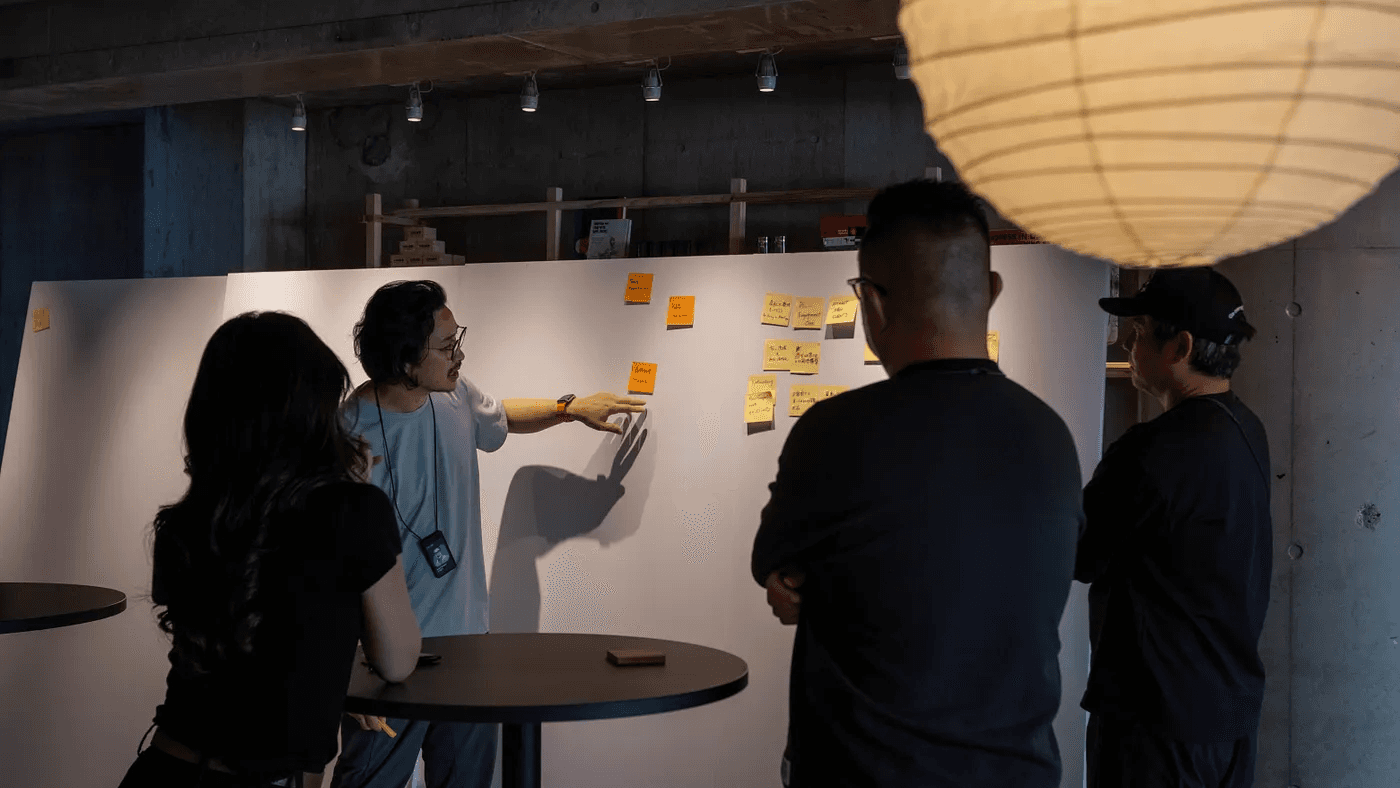
Pairing: It is not just about splitting work, but about exchanging ways of thinking. Sitting side by side, solving problems, one person’s perspective stimulates and expands the other’s. This is not simply knowledge transfer but a sharing of how we think, laying the foundation for strengthening a team’s collective reasoning.
Everyday Conversations and Dialogues: Not just opinion exchanges, but facilitated dialogues where everyone participates and diverse perspectives emerge. We always clarify why we are having the conversation, but on that journey, we practice both divergent thinking to broaden ideas and perspectives, and then convergent thinking to focus and reach a decision. This rhythm is the essence of good conversations, especially those that lead to decisions.
Balanced Team: No single expert monopolizes the thinking. Designers, engineers, and PMs — all roles participate in the entire thinking process. It is not a mere division of roles, but a structure where thinking is embedded in every stage, from defining the problem to execution and learning, leading to more sustainable solutions.
Cycles of Experimentation and Learning: Work at Bekind Labs never ends with a plan. We run small experiments based on hypotheses and learn from the results, creating cycles where every member reflects and expands their thinking. The most important outcome is not simply results, but the fact that our collective thinking is renewed and strengthened every day.
Looking back, I feel that each of Bekind Labs’ working habits may well be a device that ensures thinking does not remain in the hands of a few, but returns to everyone.
Thinking Belongs to Everyone
What my colleagues at Bekind Labs and I do may not simply be about growing a company. What we truly pursue is to help people reclaim their right and opportunity to think for themselves — in other words, to be enablers of thinking. This applies not only to our own employees, but also to the client teams, partners we work with, and the broader networks connected to them.
In the age of AI, this goal feels more urgent than ever. Technology should not replace thinking, but help expand and catalyze it through relationships. In this way, people do more than deliver product outcomes — they also experience an environment where they feel respected, grow, and work happily.
This is how I envision Bekind Labs: an environment where thinking is not confined to a few, but rather flows back to everyone, enabling work that is both meaningful and joyful. That, I believe, is the ultimate vision we strive toward.
[Epilogue]
But why did I give such an unexpected answer — “to become a Buddha”?Looking back, Buddha is not someone who gives answers, but someone who opens the path for others to realize the truth themselves. The words slipped out unconsciously, but in the end, they align with the kind of leadership I aspire to — an enabler who gives thinking back to everyone.
And before Soo left, I shared this conclusion with her once more. Those spontaneous yet honest answers and questions ultimately helped me clarify my own thinking. I remain deeply grateful to Soo for sparking such a meaningful conversation.